

Scope of work: remove failing drywall tape and refinish the area; drywall repairs and retexture to match; prime the repairs; fill the window trim with wood filler for a smooth finish; caulk the trim joints and the seams where trim meets wall; two matte coats of Benjamin Moore Aura on the walls and ceiling; two sprayed satin coats of the same Aura color on the trim — one color throughout.
What is color drenching?
Color drenching means painting a room’s walls, ceiling, and trim in the same color, instead of the default white ceiling and white trim. It sounds simple, and the effect is bigger than people expect. Most rooms are full of contrast lines — where the wall meets the ceiling, where the casing meets the wall, along every baseboard. Those lines tell your eye exactly where the room stops. Take them away and the corners soften, the boundaries blur, and the space feels enveloping instead of boxed in.
On a vaulted ceiling like this one it pays off twice. Carrying the color up the slope draws the eye along the full height of the room rather than stopping it at a white line partway up.
The part people miss is the sheen. Drenching doesn’t mean one product everywhere. Here the walls and ceiling are Benjamin Moore Aura in matte — it swallows light, hides surface irregularities, and keeps big planes from showing roller flashing. The trim is the same Aura color in satin. That small sheen shift is enough that casings and baseboards still read as trim and catch a little light, without a color change breaking the effect.
The color itself is a deep, warm brown — earthy rather than cool or grey. It behaves differently through the day, which is part of the appeal: soft and muted when the room fills with daylight off the trees outside, then rich and close under the chandeliers at night. Paired with the warm wood floors it lands somewhere between cozy and formal — a room you want to sit in rather than pass through.
Why color drenching needs better prep
One color across every surface removes the visual breaks that normally hide imperfections. There’s no white ceiling line to distract from a wavy corner and no color change to disguise a rough casing — so the prep has to be tighter than a standard repaint, not looser.
- Failing tape removed and refinished. We pulled the drywall tape that had let go, refinished the area, and brought it back flat.
- Retextured to match. Repairs were retextured so the patch disappears into the surrounding wall instead of telegraphing under a matte finish.
- Primed. Repairs primed so they don’t flash through the finish coats.
- Window trim filled. Wood filler over the trim profile, sanded smooth — with the trim now the same color as the walls, any nail hole or open grain would read as a defect.
- Caulked. Trim joints and the seams where trim meets wall, so the transition disappears completely.
- Trim sprayed, two coats. Sprayed satin for a hard, even film with no brush marks.
One color, three different rooms
All three photos below are the same room, the same paint, the same day’s work. Nothing was recolored between them — the only thing that changed is the light. This is the part of color drenching that surprises people, and it’s worth understanding before you pick a color rather than after.
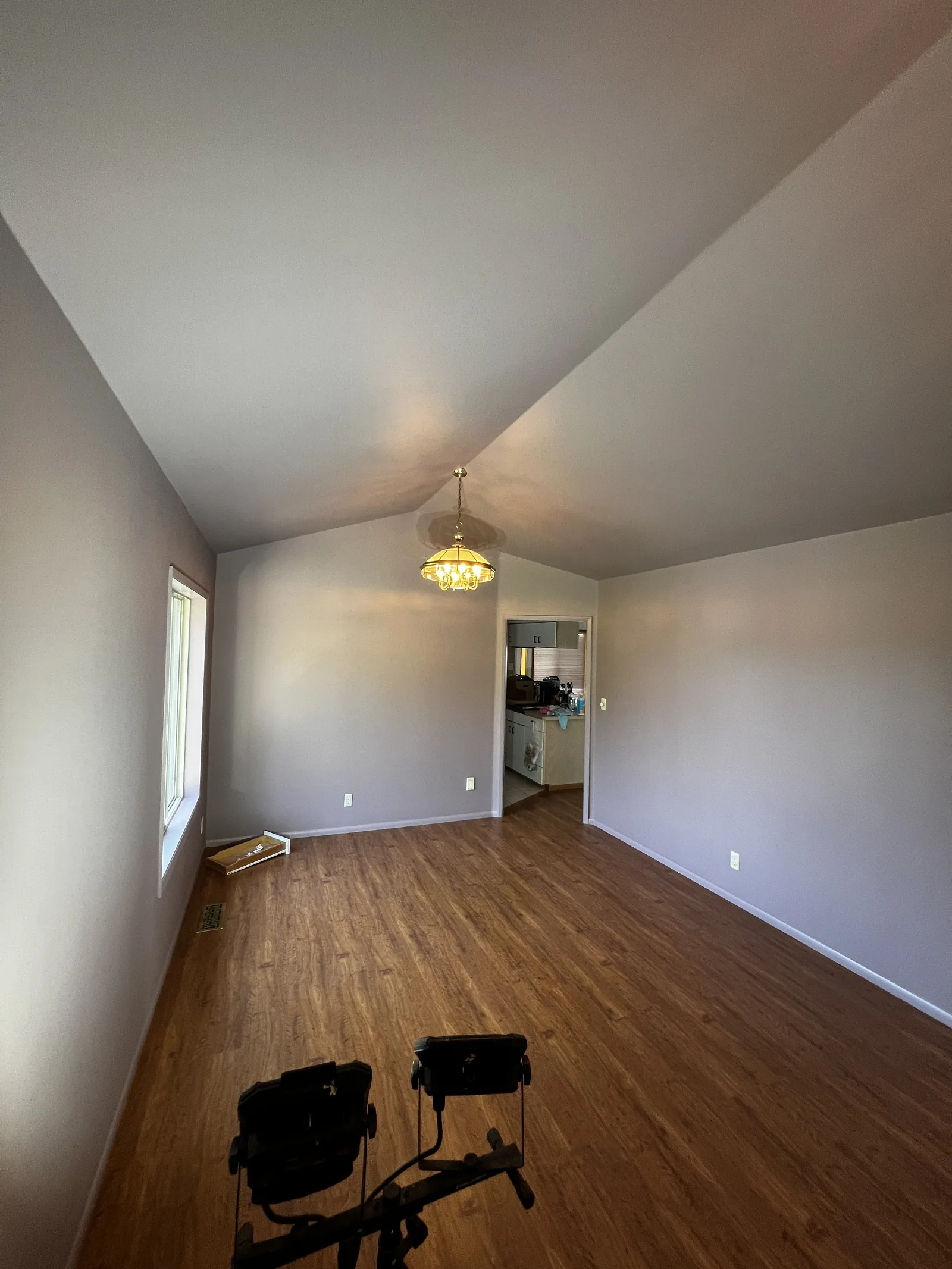


Two things are happening. First, you’ve removed the white reference. In an ordinary room the white ceiling and white trim act as a fixed neutral your eye calibrates against, which keeps the wall color looking roughly the same all day. Drench the room and that anchor is gone, so the color simply follows whatever light is in the room.
Second, the color compounds. When every surface is the same, light doesn’t bounce off a white ceiling and come back neutral — it bounces between colored surfaces and picks up more of that color on each pass. A drenched room effectively tints its own ambient light, which is why the deep version looks richer than a single wall of the same paint ever would.
The sheen split shows up here too. Matte scatters light in every direction, so the walls and ceiling stay even and absorb the room. Satin has a specular component, so the trim throws a highlight and can read noticeably lighter than the walls at a glancing angle — even though it’s the identical color out of the identical can. That’s the effect doing its job, not a mismatch.
Practical takeaway: sample a drenched color on more than one wall, and look at it in the morning, mid-afternoon, and at night with your actual bulbs on. A drenched room swings further between lighting conditions than a conventional one, so a color you judged at noon can be a different room by 8pm. In this case the homeowner got both — airy in the day, close and library-like at night.
Color drenching questions we get
What is color drenching?
Color drenching is painting the walls, ceiling, and trim of a room in the same color instead of using a white ceiling and white trim. Without the usual contrast lines, the eye stops reading where the wall ends and the ceiling begins, and the room feels like one continuous, enveloping space.
What sheens should you use when color drenching a room?
On this Bellingham project we used Benjamin Moore Aura in a matte finish on the walls and ceiling and the same Aura color in satin on the trim. The matte hides surface irregularities and keeps large wall and ceiling planes from showing roller flashing, while the satin trim adds a subtle sheen shift so doors, casings, and baseboards still read as trim without breaking the color.
Why does a color drenched room look so different at different times of day?
Because you have taken away the white reference. In a normal room the white ceiling and white trim give your eye a fixed neutral to judge everything else against, so the wall color looks fairly stable all day. Drench the room and that anchor is gone, so the color follows whatever light is in the room. There is a second effect too: when every surface is the same color, light bounces between them and picks up more of that color on each bounce, which deepens and saturates it. This room is the same paint in all three photos on this page, and it moves from a soft greige in full daylight to a deep chocolate brown under the chandeliers.
Does a dark color drenched room make the space feel smaller?
Usually the opposite. Painting the ceiling and trim to match removes the contrast lines that tell your eye where the room stops, so the corners soften and the boundaries blur. On a vaulted ceiling like this one it emphasizes the height rather than shrinking it.
Does color drenching need more prep than a normal repaint?
Yes. A single color across every surface removes the visual breaks that normally hide imperfections, so flaws in the drywall and trim show more. On this project we removed failing drywall tape, refinished the area, retextured to match, primed, filled the window trim with wood filler for a smooth finish, and caulked the trim joints and the seams where trim meets wall before spraying.
Thinking about color drenching a room in Bellingham?
Color drenching lives or dies on prep and on getting the sheens right, and it’s worth having someone walk the room with you before you commit to a color. We do interior painting — including drywall repair, retexture, and sprayed trim — across Bellingham and Whatcom County. See more of our work in the Bellingham portfolio, check our painting prices, read customer reviews, or request a free estimate.